

Picking a faction in Full Spectrum Dominance is a bigger decision than it looks. FSD gives every army the same activation dice engine, but each faction bends that engine in its own direction: one chains orders down a command ladder, one drops pods out of orbit, one fields a handful of walking gun platforms that cost more than your whole infantry line. Pick one that fights against how you like to play and you’ll have a long night.
So here’s our field guide to all six playable factions: who they are, how they want to fight, where they’re strong, where they crack, and how to beat them when they’re across the table from you. New to the game? Start with our Getting Started with Full Spectrum Dominance post first, then come back here to pick your side.
A note on the rating cards: the bars are our own Xpidemix field rating from games at the table, not official numbers. They’re there to show each faction’s shape at a glance. Your list building can push any of them up or down a notch.
The six factions at a glance
| Faction | In one line | Pick them if you like… |
|---|---|---|
| The Tech | Machine war-hordes that jump across the board | Surprise angles and tough, flexible units |
| The Enlisted | Human combined arms with a chain of command | Classic infantry-and-tanks play and tight coordination |
| The Union | Factory crawlers and swarms of cheap troops | Big numbers, sabotage, and big industrial monsters |
| The Conglomerate | Corporate long-range control and drop pods | Shooting from range and deploying exactly where it hurts |
| The Corsairs | A few elite, heavily armed Rigs | Planning ahead and making every activation count |
| The Reclaimed | Slow concrete-and-steel giants with Warden support | Grinding the enemy down and holding ground |
One more thing before we start: in FSD a faction’s unit profiles can stand in for several different groups in the lore. Your Enlisted might be one colonial army, your mate’s might be another, and they still use the same cards. Paint them however you like.
The Tech
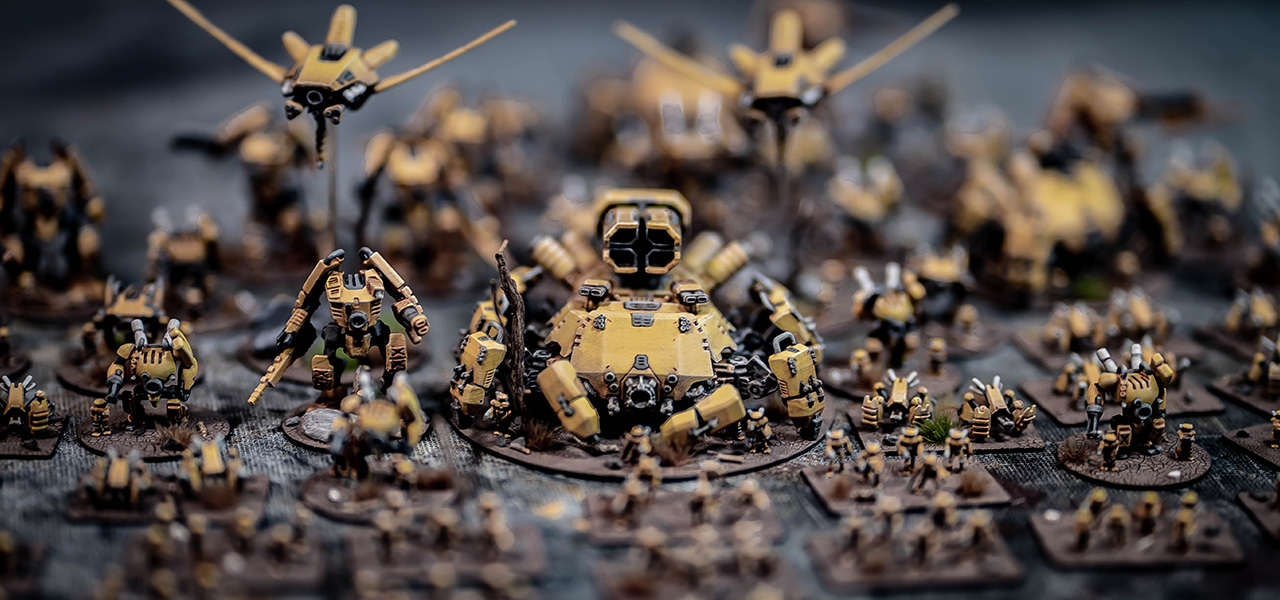
Who they are: Synthetic war machines born from the Singularity, the military arm of a gestalt machine intelligence that sees organic life as waste. They range from little Spider Droids dropped ahead of an invasion up to towering bipedal war machines.
Playstyle: The Tech aren’t fast on the ground, but their mechs can use jump packs to leap across the battlefield. That’s the whole personality of the faction: you threaten areas your opponent thought were safe, then land somewhere awkward for them. Spider Droids screen and grab space early while the big walkers set up the hammer blow.
- Strengths: Unpredictable mobility from the jump packs, sturdy units, strong mid-to-heavy firepower, and the ability to reposition onto objectives late in the game.
- Weaknesses: Fewer bodies on the table, so every loss stings. Ground movement is slow when you’re not jumping, and a jump that lands in the open is very hard to take back.
Tactics: Don’t jump just because you can. The threat of a jump is often worth more than the jump itself, because it forces your opponent to spread out and guard flanks. Keep the walkers just out of sight, use the Spider Droids to soak early fire and contest objectives, then jump onto the decisive point in the turn when it actually matters. Land behind cover, not in front of it.
How to beat them: Deny landing zones. Keep reaction fire covering the open ground near objectives so any mech that jumps in eats shots straight away. Thin out the Spider Droid screen early so the big units are exposed, and focus fire. A Tech army that loses two big machines usually has nothing left to replace them with.
The Enlisted
Who they are: Human colonial forces cut off from Old Earth after the Singularity. Not the toughest or the most advanced army in the system, but stubborn and adaptable, mixing several kinds of infantry with a wide spread of vehicles.
Playstyle: This is the most “traditional” army in FSD, and its signature is the chain of command. The Enlisted can chain activations, starting from a unit with a high command value and cascading down to units with lower ones. Done well, a whole section of your army moves and fires as one coordinated push.
- Strengths: Excellent coordination through chained activations, a flexible roster that can be built infantry-heavy or tank-heavy, and good numbers on the table.
- Weaknesses: Lighter armour than most opponents, so they lose trades if they get caught piecemeal. The chain depends on your high-command units staying alive and in position; lose them and the army slows down noticeably.
Tactics: Build your deployment around the chain. Keep command units close enough to the troops they need to activate, and protect them like the objective they basically are. Use the chain for the big moments: one sweeping turn where infantry advance, armour fires, and support units all go together is how the Enlisted win fights they shouldn’t. Use cover generously, because your troops can’t afford to stand in the open.
How to beat them: Go for the head. Target the high-command units early and the cascade starts breaking up. Spread the fight across the table so their units drift out of command range, and look to win attritional exchanges, since you’ll usually out-armour them.
The Union
Who they are: Workers of the abandoned Factory-cities who unionised, seized the means of production and turned their industry into a war machine. Everyone in the system wants their factories, and the Union is ready to hold the line.
Playstyle: The Union gives you two very different armies in one box. You can field a few vast crawling war machines for a direct assault, or flood the table with cheap vehicles and fast infantry who specialise in demolition and sabotage. The best Union lists often blend both: a big machine that demands attention while the swarm does the real work.
- Strengths: The highest body count in the game if you want it, cheap units that trade well, sapper-style infantry that are dangerous up close, and huge crawlers that soak a lot of fire.
- Weaknesses: Individual units are fragile and fairly basic. A swarm list can be awkward to manage with a limited supply of activation dice, and the big crawlers make an obvious target.
Tactics: Play the numbers game on objectives. You can afford to lose units that your opponent can’t, so be aggressive with the cheap stuff and make them spend fire on it. Use the fast infantry to get into buildings and close quarters where their demolition skills count. If you bring a crawler, push it straight up the middle as the lightning rod and let everything else flow around it.
How to beat them: Don’t get distracted by the crawler if the swarm is taking your objectives. Prioritise the sapper infantry before they reach your lines, keep your heavy units away from close quarters, and use area denial to slow the tide. Union units die easily; make sure you have enough shots to keep up with how many there are.
The Conglomerate
Who they are: The corporations, and their mass-produced, morality-free armies. They don’t care about the Tech’s existential war; they care about resources and shareholder returns, and they bring some of the best equipment money can buy to get them.
Playstyle: Control the battlefield from a distance. The Conglomerate leans on cutting-edge weaponry and strong logistics, and its unmanned orbital drop pods let it put forces exactly where they’re needed to counter whatever the opponent is trying to do.
- Strengths: The best long-range firepower in the game, flexible deployment through drop pods, and the ability to react to your opponent’s plan instead of committing early.
- Weaknesses: Less comfortable when the fight gets close and messy. A Conglomerate player who drops in at the wrong moment, or lets the enemy close the distance, loses the advantage that makes the army work.
Tactics: Set up long firing lanes and make your opponent cross them. Hold drop pods back until you’ve seen where the enemy is committing, then land on the flank or the objective they left lightly guarded. Patience wins with this army; the moment you start chasing, you’re playing their game.
How to beat them: Close the distance fast and use terrain to break their lines of fire. Keep a reserve near your objectives so a late drop doesn’t steal a point for free. Put pressure on early so they have to commit their pods before they want to.
The Corsairs
Who they are: Highly trained pilots living aboard Whaleships that drift between the surviving systems. Don’t call them mercenaries: they follow a strict code and fight under a Letter of Marque issued by a nation or corporation, then run their own campaigns and take their own spoils.
Playstyle: Elite and few. Each Corsair Rig is a costly, high-maintenance piece of kit, but it carries incredible firepower and can take a hit or two. Lighter Rigs provide support and intel, and flying Albatross drones coordinate with the pilots through faction-specific rules. The medium and large Rigs have swappable weapon options, so list building changes a lot depending on how you arm them.
- Strengths: Unmatched firepower per unit, tough Rigs, drone support, and a lot of loadout flexibility.
- Weaknesses: Very few units, so objectives and activations are always tight, and every loss is a big chunk of your army. To use all that firepower at the right moment you have to plan ahead and save your activation dice, which makes this the least forgiving faction for new players.
Tactics: Think two activations ahead. Know which Rig needs to fire when, and keep dice back for it rather than spending them as they come. Use the Albatross drones and light Rigs for spotting and to contest objectives so your heavy Rigs don’t have to. Focus fire: two Rigs deleting one enemy unit is better than two Rigs half-damaging two units.
How to beat them: Play the objectives, not the Rigs. Spread out, flood the scoring areas with cheap units, and make them choose what to shoot. Kill the drones and support Rigs so the heavies lose their eyes. Bait out their saved dice with a threat they have to respond to, then hit somewhere else.
The Reclaimed
Who they are: Quasi-sentient giants built in the abandoned factory-cities from scavenged Tech AI cores, wrapped in layers of concrete and tempered steel. Clumsy and hard to control, but extremely sturdy and cheap to build and repair, they patrol set routes around their cities and flatten anything in the way.
Playstyle: Slow, heavy and relentless. The army is built around Centaurs (heavy robots), Cyclops (main battle robots) and Trolls (cheaper, more disposable support). Supporting them are Wardens, lightly armoured (or unarmoured) figures that follow the robots without acting as units themselves. Many of the faction’s best abilities need a Warden nearby, so moving them carefully is a big part of playing well.
- Strengths: The toughest units in the game, good value for their cost, and the staying power to win long, grinding fights over objectives.
- Weaknesses: Very slow and not especially agile. The Wardens are a real weak point: lose them, or let them drift out of position, and your robots lose a lot of what makes them dangerous.
Tactics: Deploy close to where the fight will be, because you won’t get there quickly later. Walk forward as a block, use the robots’ bulk to shield your Wardens, and keep each Warden tucked behind the unit it supports. Use Trolls as the disposable screen so the Centaurs and Cyclops arrive intact. Take the middle and make your opponent come to you.
How to beat them: Hunt the Wardens. Anything that can reach around the robots to hit them is worth its points. Otherwise, out-manoeuvre: spread objectives out, score on the flanks they can’t reach in time, and don’t get pulled into a slugging match in the centre.
Coming next: the Swarm
FSD’s newest expansion, SWARM Mode, adds solo and co-op play against two new opponents. The Hive are crab-like creatures from beneath the planet Ruun: claws for close combat, no ranged attacks, and sheer numbers to make up for it, with the Brute and the Breeder as the very hard-to-kill big ones. The Detached are broken Tech constructs that lost their link to the central intelligence and now simply march toward the nearest enemy, still able to shoot and even jump on occasion. Instead of a flowchart AI, the Swarm is driven by its own activation dice and Collective Cards, and you choose the “lesser evil” command each time. The campaign roadmap also lists a fully player-controlled Hive force as a stretch goal, which would make it the seventh playable faction. We’ll do a proper write-up once we’ve had it on the table.
So which faction should you start with?
- First army, want to learn the game: the Enlisted. They teach the core engine without hiding anything.
- Like big numbers and chaos: the Union.
- Like sniping from a distance and outthinking people: the Conglomerate.
- Like surprise and tough units: the Tech.
- Like a small, beautiful collection and don’t mind a steep curve: the Corsairs.
- Like walking straight forward and not dying: the Reclaimed.
Every faction page on the official FSD website has three sample 60-point lists, which are a great way to try an army before you commit. When you’re ready to put a list together, use our FSD Army List Builder: it’s free and covers every faction, including the latest units and Behemoths. The official models are on The Lazy Forger’s store, and if you don’t have a printer, FSD keeps a list of authorised 3D printers.
Want to try a few factions before you pick? Come down to the Xpidemix store at 1004 Toa Payoh North for an FSD game, or book a table and bring your own army. We’re always happy to teach.